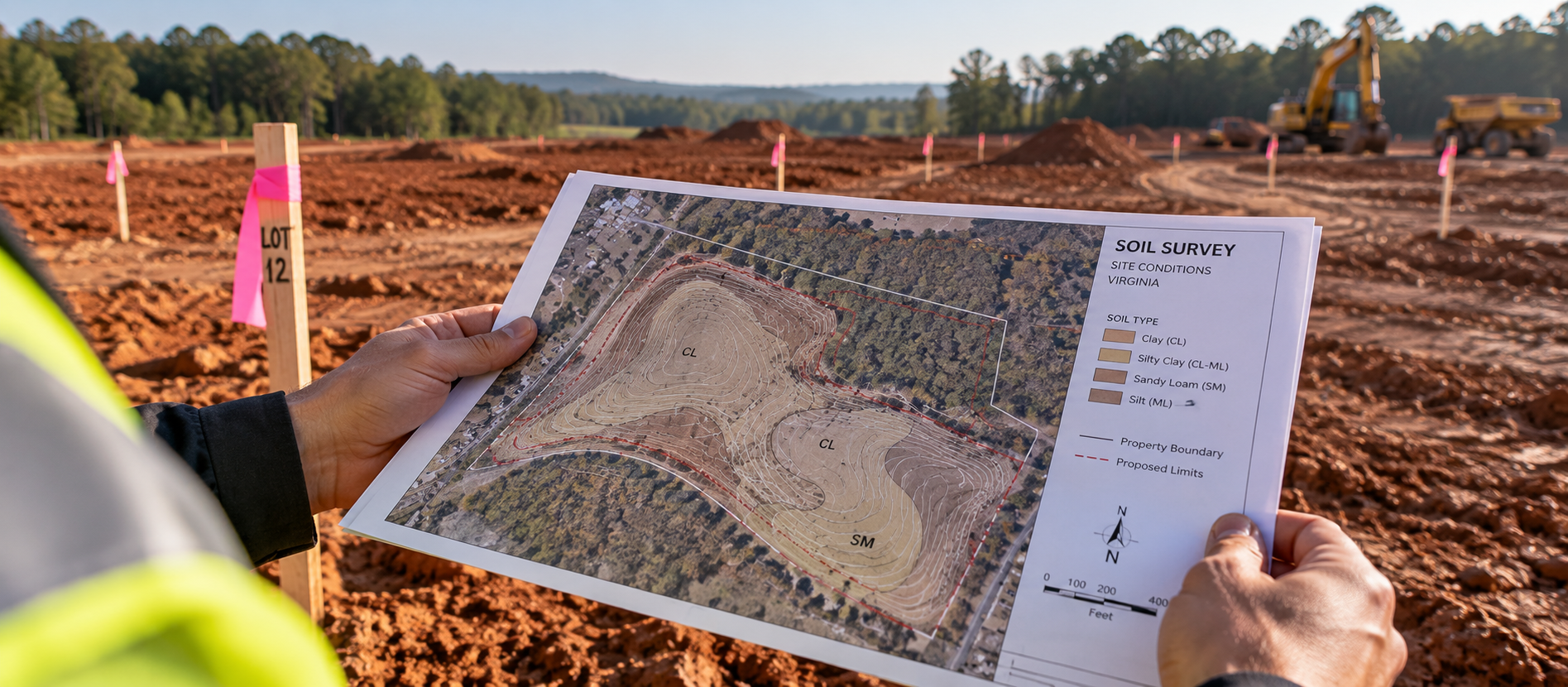
Before closing on land, developers routinely spend thousands on title work, surveys, and environmental Phase I reports. Then many of them skip the question that most often decides whether the deal pencils: what is the dirt going to cost me? The answer is sitting in a public federal database, and screening it costs less than lunch for the deal team.
The five soil hazards that change Virginia deals
- Marine / shrink-swell clay — expands and contracts with moisture; drives undercuts and foundation upgrades. Endemic in Northern Virginia; we wrote a full breakdown.
- High water table — inside a few feet of the surface across much of Hampton Roads and the coastal lowlands; means dewatering, stone, and wet-weather schedule risk.
- Organic soils and muck — compressible material that cannot carry load; must be removed or surcharged. Common in bottomlands and old pond sites.
- Karst — the Shenandoah Valley's dissolving limestone: sinkholes, pinnacle rock, and stormwater complications.
- Shallow rock — mass and trench rock excavation at $95–165+ per cubic yard turns routine grading and utility runs into premium work.
What a $350 screen actually tells you
A DirtBid Soil Report reads the official USDA soil survey for your exact parcel and translates it into development terms: which soil series dominate the site, their shrink-swell behavior, drainage class and seasonal water depth, hydric (wetland-indicator) status, and depth-to-rock signals — then layers on the county's risk profile from our 133-jurisdiction model and suggests remediation line items at current regional unit rates. Ten minutes after you paste the location, you know whether this parcel is a green light, a negotiate-harder, or a walk-away.
What it honestly can't tell you
A desktop screen maps likelihood, not certainty. It samples nothing and sees nothing below the mapped horizon — it will not catch an unrecorded fill pit or give you bearing capacities for foundation design. That work belongs to a geotechnical engineer with a drill rig, typically $10,000–25,000 well spent. The screen's job is to tell you whether and where that money should be spent — and to arm the land negotiation before you're committed.
The five-minute desk screen anyone can run
Even before spending the $350, you can triage a parcel from your desk. Pull the county GIS and look at what surrounds the site — stormwater ponds clustered oddly, or a neighboring subdivision with conspicuously deep lots, often trace old drainage problems. Check the topography: land that's dead flat next to a stream got that way by flooding. Look at the parcel's history on aerial imagery — farm ponds, old borrow pits, and demolished structures all mean buried surprises. None of this replaces the soil data; it tells you how urgently you need it. A parcel that trips two of these wires shouldn't get an offer before it gets a screen.
Questions to bring your geotechnical engineer
When the screen says "escalate," make the geotech money count. Ask for borings concentrated where the screen flagged risk, not a uniform grid — the same budget buys twice the insight. Ask explicitly: what undercut depth should we carry, and over what area? Can flagged clays be stabilized in place instead of exported? What groundwater did you actually hit, and in what season? And request the answer in quantities, not adjectives — "anticipate 2 to 4 feet of undercut across the southern pad" prices directly into a budget; "soft soils may be encountered" prices into nothing. A geotech report written for estimators instead of lawyers is worth every dollar of its fee.
Cheap questions, expensive silence
A recent Richmond-area project absorbed a ~$250,000 unforeseen-soils change order that public data would have flagged — the story is worth reading before your next land contract. The dirt always answers eventually. The only choice is whether you ask at $350 or get told at $250,000. Screen your next parcel before you sign for it.