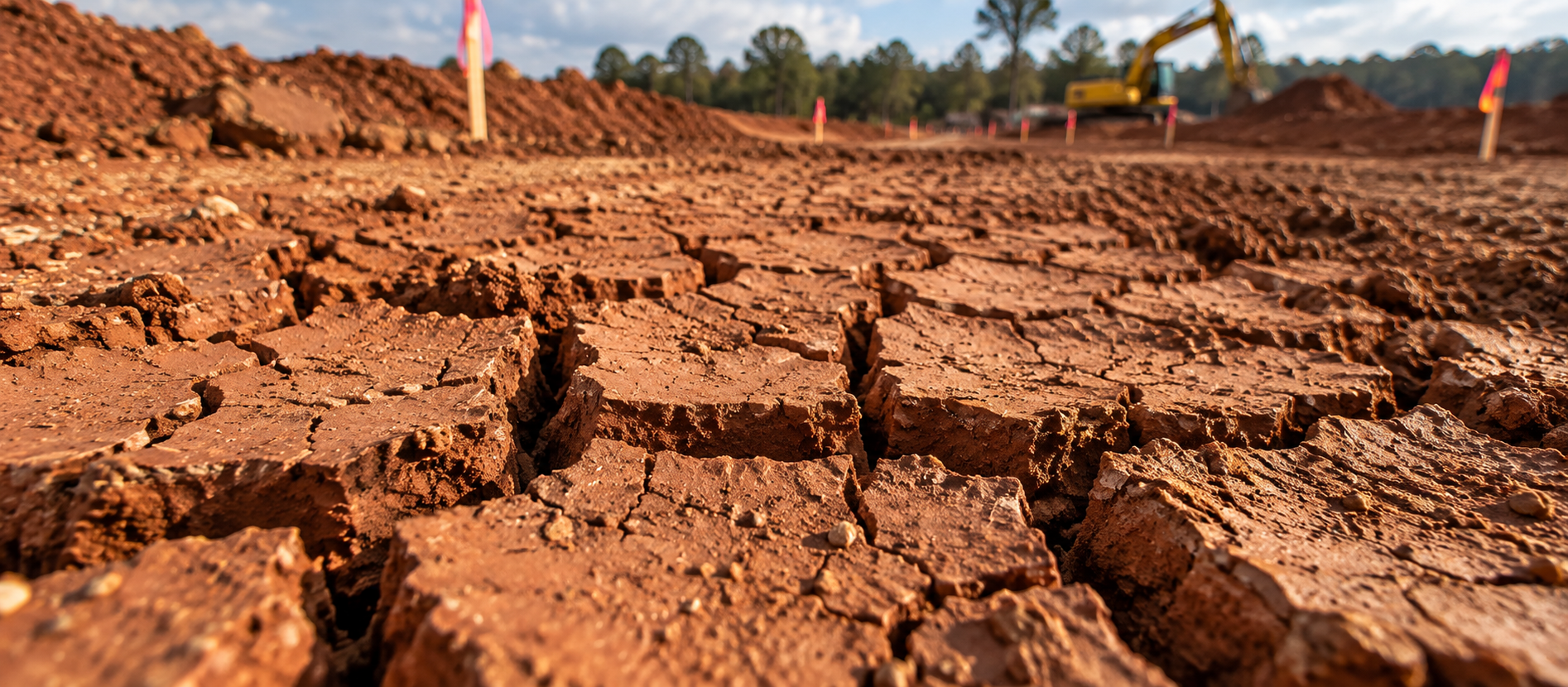
Ask any veteran Northern Virginia sitework contractor for their worst story and odds are it involves marine clay. These are the plastic, slickensided clays of the Potomac Formation — ancient marine sediments underlying big swaths of Fairfax, Prince William, and Alexandria — and they have ended more budgets than any other ground in the Commonwealth.
What makes marine clay different
Marine clay is a shrink-swell soil: it expands when wet and contracts when dry, cycling with the seasons. Build on it untreated and the movement cracks slabs, racks foundations, and heaves pavements. It also drains poorly and loses strength when disturbed — an excavation that looked stable on Friday can be a pudding pit after a weekend of rain. Local jurisdictions know it well: Fairfax County maintains special "problem soils" provisions precisely because of this formation.
What it does to a sitework budget
- Undercut and replace — the standard fix: excavate the unsuitable clay below pads and pavements and rebuild with select fill. Current Virginia pricing runs roughly $30–62 per cubic yard combined (excavation, export, imported fill, compaction). Real executed contracts we track have settled near the middle of that band.
- Moisture conditioning & lime treatment — sometimes the clay can stay, chemically stabilized; cheaper than full undercut when conditions allow.
- Foundation upgrades — where clay runs deep, the answer moves from earthwork to structure and costs migrate to the building budget.
- Schedule drag — clay work is weather-hostage; wet seasons stretch grading durations and carry costs.
Screening before it's your problem
The presence of Potomac Formation soils is mapped. The USDA soil survey identifies the series, their shrink-swell potential (the "linear extensibility" that engineers watch), drainage class, and depth characteristics for essentially every NoVA parcel. A desktop screen tells you in minutes whether a site sits on suspect ground, roughly how much of it, and what the remediation math looks like at real unit rates — which is exactly what a DirtBid soil report automates.
Screening isn't the end of diligence — confirmed marine clay absolutely justifies geotechnical borings before final design. But it changes when you learn the truth: at the letter-of-intent stage, when the price of dirt knowledge is leverage, instead of at the grading stage, when it's a change order.
Reading the USDA clues like an estimator
You don't need a soils degree to read the warnings. In the survey data, three signals mark trouble: linear extensibility (the measured shrink-swell number — values in the high single digits mean the soil moves enough to damage what sits on it), drainage class (anything "somewhat poorly drained" or worse on a building site deserves a hard look), and the soil series name itself — in NoVA, names from the Potomac Formation family are their own warning label. Cross-reference the mapped extent against your site plan: clay under the stormwater pond is a nuisance; clay under the building pads is a budget event.
What the remediation decision actually looks like
Once clay is confirmed, the choice is rarely all-or-nothing. Estimators run the same triage every time: shallow pockets under pavements get undercut and replaced — the $30–62/CY math — because pavement tolerates modest residual movement. Deeper deposits under structures get evaluated for lime or cement stabilization, which can halve the cost when the clay's chemistry cooperates. Deposits too deep to chase get handed to the structural engineer, and the money moves from earthwork into deeper foundations. The worst outcome isn't any of these — it's discovering which one you need after the grading contractor has mobilized, when every option costs change-order rates and schedule. The screen-first sequence exists to make this a design decision instead of a crisis.
The takeaway
In most of Virginia, soil risk is a line item. In marine clay country it can be the whole deal. If you develop or bid in NoVA, make parcel-level soil screening as routine as a title search — the ground there has earned the paranoia.