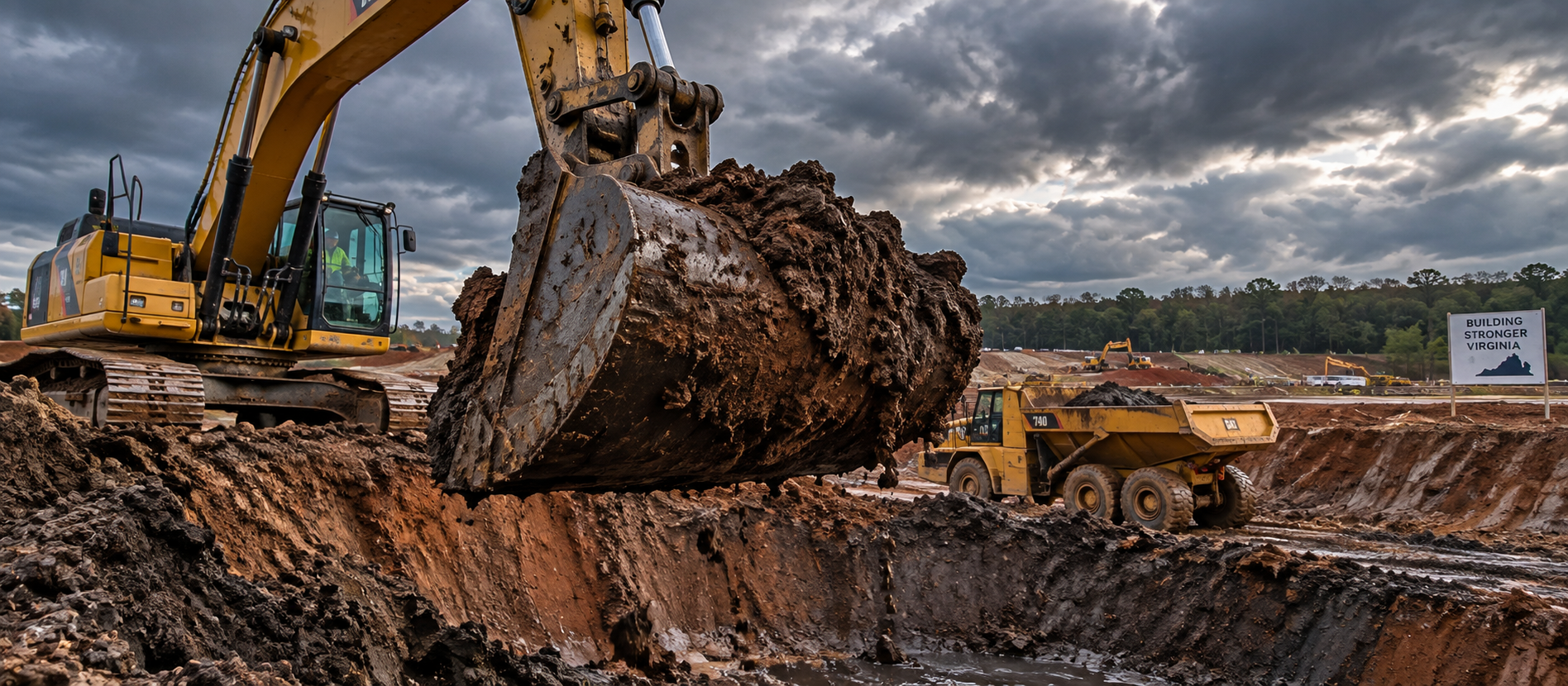
A Richmond-area development recently signed a sitework contract just under $2 million. Standard terms, competitive number, experienced contractor. Months later the developer approved a change order for roughly $250,000 — a 13% jump — for removing and replacing unsuitable soil the grading operation uncovered. Nobody behaved badly. Everybody followed the contract. The contract just said, as nearly all of them do, that surprise dirt is the owner's problem.
The boilerplate that does the damage
Read any sitework proposal and you'll find an exclusions list like this one, taken from a real executed contract:
- Rock excavation, contaminated soils, unsuitable soils, and hazardous material removal are all excluded
- Select backfill of utility trenches is excluded
- Geotechnical testing and inspections are excluded
- Relocation of encountered obstructions or utilities is excluded
None of this is sneaky — a contractor genuinely cannot price what nobody has seen. The sophisticated ones go further and pre-agree unit rates for the unknowns: undercut and export at $32 per cubic yard, imported fill compacted in place at $24.50. Which means when bad ground appears, the change order writes itself: quantity × rate, no negotiation, no leverage. At a combined ~$56.50 per cubic yard, that $250,000 surprise was about 4,400 yards of bad dirt — a pocket of soft ground the size of a small building pad.
The part that stings
The information that would have predicted it was free the whole time. The USDA's soil survey — the same data geotechnical engineers pull first — maps soil series, drainage class, and engineering limitations for essentially every parcel in America. A pre-contract screen of that data flags the likelihood of undercut conditions before anyone signs anything. It doesn't bore holes; it tells you where boring holes is worth the money.
Four moves that protect your budget
- Screen before you sign — land contract or construction contract, know the soil story first. A $350 Soil Report is the floor.
- Carry an informed reserve — if screening flags undercut risk, budget it as a line item at real unit rates, not as a vague contingency percentage.
- Negotiate the rates while you have leverage — pre-agreed undercut and import rates are fine; negotiate them at bid time, when contractors are competing, not at discovery time, when they aren't.
- Spend geotech money where the screen points — targeted borings in the flagged zones beat a uniform grid for the same budget.
Why contractors genuinely can't price it
It's tempting to read the exclusions list as risk-shifting gamesmanship. Mostly, it isn't. A contractor bidding competitively cannot carry the cost of soil conditions no one has verified — whoever guesses the most pessimistically loses the job to whoever guesses optimistically, and the optimist then goes broke or claims their way back to even. Excluding the unknowns and pre-pricing the remedies is the industry's honest equilibrium: it keeps bids comparable and moves the uncertainty to the only party who can actually resolve it early — the owner, who controls the site before contracts are signed. The system works. It just punishes owners who don't use their window.
Anatomy of the change order, hour by hour
Here's how discovery actually unfolds. The grading foreman's dozer starts pumping — the ground flexing under the tracks like a waterbed. Work in that zone stops the same morning. The contractor notifies the owner in writing (their contract requires it, usually within days), the parties walk the area, and a testing firm probes the extent. Then the arithmetic that was agreed months earlier takes over: measured quantity, times the pre-agreed undercut rate, plus import fill at its rate, plus any schedule impact. By the time the paperwork lands on the developer's desk, there is nothing left to negotiate — only to fund. The entire outcome was determined the day the contract was signed without a soil screen.
Boilerplate is a choice
"Unsuitable soils excluded" will stay in contracts forever — and it should. What's optional is walking into that clause blind. The developers who treat soil screening as a deal-stage habit turn the industry's most notorious surprise into just another priced line item. Start with the regional risk picture, then screen the parcel itself.